
Music… or not…
I think I’m a failure in terms of fitting into the writer’s mould.
I don’t sit and write in a study. (I write anywhere and everywhere)
I’m not surrounded by learned tomes. (Hard when you write anywhere and everywhere)
I think I’m a failure in terms of fitting into the writer’s mould.
I don’t sit and write in a study. (I write anywhere and everywhere)
I’m not surrounded by learned tomes. (Hard when you write anywhere and everywhere)
I don’t think many people really know how sweet my tooth is. Well, maybe Shea Mcleod does, as you’ll see on Sept 7th on her blog.
But I crave sweet stuff. If I go out, I look at the dessert menu first and then order small, ‘lite’ pre-cursers. I cook to stop the family from starving, but I truly ‘cook’ when I make sweet stuff. A terrible admission in these days of sugar overload. Actually, when the terrible January 2011summer storms wiped out the Queensland (Australia) sugar harvest, I, along with many others, stockpiled sugar in the pantry.
 Shéa MacLeod once told her mother she wished life was more exciting. It was only later she realized you should be careful what you wish for. Her adventures have led her from the Scottish Highlands to the shores of Maui. She’s tried belly dancing and samba. She’s been a soap maker and candy seller. She even tried her hand at massage therapy. And she knows how to milk a goat. Shéa is the author of urban fantasy post-apocalyptic scifi paranormal romances with a twist of steampunk.
 On learning…
It’s an age since a Pillowbook has appeared on the blog. A Pillowbook, if it is in the style of Sei Shonagon, is a sharp-eyed look at life, maybe even acerbic. The last few months have been too… soulful for me to be acerbic. I re-learned how grief can pull you apart. How kind attention and love can put you back together. How loyal friends stick by you, how loyal readers keep you focused and stay loyal no matter that the book you have promised them seems like a mirage.
I was thinking today (I do that sometimes) what would have happened if I had never ever taken up the offer of publication in 2008, when YWO.com set up their print publishing scheme for new writers.

Taking advice from the indie faerie!
Please excuse my absence for a few days… I’ve got a lot of typing lined up over a very short space of time as I answer questions from interested bloggers and readers. Hopefully the occasional Red Chair will occur here as A Thousand Glass Flowers moves ever closer to release.
Gisborne deserves to be placed in its timeframe. What began as a bit of fun has now moved from fan-fiction to historical fiction, historical romance and historical fantasy. Despite the fact that the legend is just that, a myth, Gisborne -the- man- of -folktale lived during the reign of Richard Lionheart and so must be placed within that period.
As the writer, I was beholden to research the period in detail: clothes, time, religious practice, food, habits, entertainment, sex, medicine, politics, trade. More and more detail to get a sense of where my protagonists lived and how they might feel in that environment at any one moment.

Stacking some of the books
The more I read, the more I found to read until I felt myself drowning in books and in PDF’S from online research.
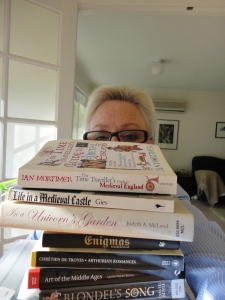
Drowning!
So how does one sort the stuff out, how much does one use? Is too much enough, or is a mere snifter required?
To be honest, I am not sure I know. I ‘ve read the doyen of historical fiction, Dorothy Dunnett with relish and literally gorged on every glorious fact she included in every line of all of the books she ever wrote. And at the other end of the scale I’ve read authors like Posie Graeme Evans and YA writer Felicity Pulman who write with a deft and sparing hand, never drowning the writer in fact; delivering just enough to give an authentic sense of time and place.
So again I ask, how much is enough? I’ve been involved in a lively discussion on Goodreads with the Historical Fictionistas about just this and personally as a reader I know I’ll accept an average amount of researched fact that any writer might want to give. Not too much. The exception to this personal reading rule is DD because it is very much her style, her tone. But as a writer writing my first ever historical fiction novel, I am still unsure how much is required. Without doubt the research must be used correctly; there shouldn’t really be any excuse for saying the clock chimed if the clock didn’t exist in the timeframe. But equally do I really want to know the detail of the canonical hours and how they worked? I love to eat chocolate but I’m not in any great need to read how its created.

My absolute favourites.
My narratives are character driven and I am inclined to only ever give enough fact to give the scene and the character veracity. I’d love to know what other historical fiction writers and readers feel about this and welcome comment! How much, dear reader, do you want to read? How much dear successful hist.fict writer, do you use in your novels?
To date, I have read 48 non-fiction texts that I have either bought, borrowed from the library or researched within the Reference Library and I’ve read over 20 PDF’s online. If nothing else, I shall have a head full of leads for another story and know the difference between chausse and bliaut!
Addendum: You might like to look at :
http://www.goodreads.com/author_blog_posts/1124578-facts-in-fiction
and also:
Greg Johnston is one of those writers I envy… a writer of unique and uncluttered prose. He manages to punch huge weight with minimal wordage. Greg has profound messages in his recently published book Consumption. He says its about our consumptive society, as you will see. I see a story about the use and abuse of friendship. It’s an elucidating, haunting book and one I recommend without hesitation. Which is why I have asked Greg to sit in the big Red Chair for a grilling.
‘Jumbuck is an Australian term for sheep, featured in Banjo Paterson’s poem “Waltzing Matilda.” ‘ Wikipedia
My life outside of writing might be a little different to the average sort. It’s great to wear a good pair of jeans, a nice sweater or shirt, to have a good hair day and have a face enhanced with good cosmetics.
I met Barbara Silkstone through the effervescent (and suddenly very quiet) Mark Williams. She bravely (some would say foolishly perhaps) agreed to interrogation in my  Red Chair which is working overtime with some high-end ‘Indie’ authors right now.